Historic and Contemporary Protest Songs Links

Little Red Song Book

Here’s some notes from the show I just hosted on KPFK in LA about the history of protest songs and contemporary protest songs and singers:

By the way, the interview I did with Pete Seeger is not yet posted up, I will be posting it on the night of Friday, October 5th, so check back for that.

Lots of Links, etc. below-

The Songs:

Here’s a blurb for each song. I see the program as being a bit of history and then bringing it up to date with great contemporary stuff. We’ll start at the beginning of the 20th century with the IWW, a One Big Singing Union who liked to parody Salvation Army bands because they had good familiar tunes. And if the Salvation Army band tried to drown out the IWW singers with their brass bands, the Wobblies could just sing along. “The Preacher and the Slave” is a song written by Joe Hill in 1911. It was written as a parody of the song “In The Sweet Bye and Bye.”

1. Preacher and the Slave by Harry “Mac” McClintockHarry McClintock was a singer associated with the IWW. He is the composer of the song Big Rock Candy Mountain, but here sings a song by Joe Hill, of whom he was a personal associate, one of very few the reclusive Joe Hill had. They, along with T-Bone Slim were the main composers of the IWW, International workers of the world. I think they had the best songs of any labor movement in America. This recording is taken from a remarkable one of a kind interview with McClintock, conducted by Sam Eskin in 1950. Click the above link to got Smithsonian Global Sound where you can buy the track, read the liner notes, etc.

Jesse James Feature Episode

What with the release of the movie “The Assassination of Jesse James by the Coward Robert Ford,” we thought we’d get with the program and do a special 1/2 hour Down Home Radio episode featuring different versions and permutations of the song Jesse James. James is an early and pervasive figure in American folk and popular culture and there are many references to him in contemporary pop/popular music, but on todays show we concentrate on some old, great!!, and rather obscure versions. Vilified, sainted and shot in the back, Jesse James lives on.

Jesse James Feature Episode

Women’s Blues

This week Henrietta, Eli and Bob Malenky play classic blues sung by and about women. Where as many times women sing songs that are from a male perspective, these songs are from their own perspective and detail their own lives. This is music created and recorded in the years after World War I, during a time of women’s liberation when they got suffrage, threw away their corsets and danced the Charleston! The show features the music of Victoria Spivey, Mamie Smith, Alberta Hunter, Ma Rainey, Lil Green, Sophie Tucker and others. The show also features a live performance by Bob Malenky of Bessie Smith’s “Black Mountain Blues.”

Women’s Blues

Rufus Crisp Feature Episode

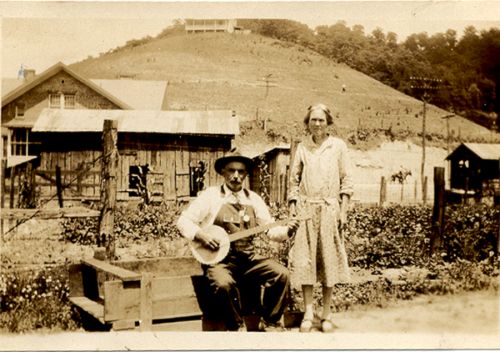
Rufus and Lulie
Rufus and Lulu Crisp

This week we focus on the music of Eastern Kentucky banjo player Rufus Crisp. About 10-20 years before the “Folk Arrival” of the early 1960’s when old time musicians such as Roscoe Holcomb, Clarence Ashley or Dock Boggs came to New York City, a few aspiring New York banjo players, including Pete Seeger, went to Allen, Kentucky and found Rufus Crisp. Crisp’s cousin was Margot Mayo, head of the American Square Dance Group (ASDG) in NYC, an important early group in the modern folk revival movement. In 1946 Mayo and fellow ASDGer Stu Jamieson traveled to Allen, KY and made extensive field recordings of Rufus Crisp, his son Palmer and fiddler Farmer M. Howell which were influential in the early Greenwhich Village scene. Today we draw heavily from these unpublished Library of Congress field recordings. We also play tracks by Stu Jamieson, heavily influenced in his own music by his contact with Crisp, and by Woody Wachtel, another New Yorker who studied with Crisp.

Rufus Crisp Feature Episode

Interview with Prof. J. Woodford Howard Jr.

This is an interview Eli conducted with Prof. Howard, nephew of Rufus and Lulu Crisp, at his home in Baltimore, MD. He grew up in the same area and provides first hand recollections of the family and regional history, social context, as well as Rufus’ music.

Nimrod Workman Feature Episode

This week, Eli & guest host Nathan Salsburg do a special episode on the music and politics of Nimrod Workman- Kentucky coal miner, union organizer, song writer and ballad singer. They play a bunch of his songs and and spoken segments, and then in the last quarter of the show play tracks from some associated musicians. They also discuss the current situation in Kentucky coal mining, including the horrendous practice of mountain top removal mining. Nathan Salsburg hosts the internet radio show “Roothog or Die” on East Village Radio. He is the production manager at the Alan Lomax Archive.

Nimrod Workman Feature Episode

Irish American Music Part 2/2 – Urban

In the first half hour of this program we conclude our 2 part mini series on the music of Irish Americans. This time we cover the sentimental pop songs of the urban Irish Catholics. These escapist, romantic love songs of early Tin Pan Alley are associated with the era of the “Gay 90’s” (the 1890’s) through perhaps the 1930’s and are tied to the early cinema. These catchy tunes have permeated American musical culture and are at the beginings of our “pop” culture.

Then in the 2nd half of the program Eli will play a bunch of music unrelated to the first half, except in that its also stuff (like sentimental pop) that you won’t usually hear on DHR. Including some Fugs, Pluto and music from the far corners of the Earth.

Irish American Music Part 2/2 – Urban

Irish American Music Part 1/2 – Rural

This week ( in the 1st half hour) Henrietta, Eli and guest host Bob Malenky play examples of the music of early immigrants from Ireland and Scotland, Protestant farmers who settled in Appalachia, and discuss the social conditions that gave rise to this music. Then in the second part of the program Eli plays some tracks he likes, but without changing the genre too much. Tune in again next week for the 2nd half of the program, featuring 19th and early 20th century popular music from the Northern urban Irish Catholic factory workers who emigrated later.

Of special note in this program is the connection between the church singing of the appalachan Primitive Baptists, and the Presbyterian church singing from the the Isle of Lewis off the coast of Scotland. They’re the same! Except one’s in English and the other’s in Gaelic. That style of singing is absolutely at the foundation of old-time, bluegrass and some early country vocal style.

Irish American Music Part 1/2 – Rural

Links:

Of special note in this program is the connection between the church singing of the appalachan Primitive Baptists, and the Presbyterian church singing from the the Isle of Lewis off the coast of Scotland. They’re the same! Except one’s in English and the other’s in Gaelic. That style of singing is absolutely at the foundation of old-time, bluegrass and some early country vocal style.

Isle of Lewis Wikipedia Article

Gaelic Psalm Singing webpage – Has audio clips

The Free Church of Scotland – Get converted


Interview with Elijah Wald

This week, Henrietta and Eli talk with musician, author and world class hitch-hiker, Elijah Wald. They discuss his latest excellent book, the pro-hitch-hiking tract, “Riding with Strangers,” as well as his book on Mexican ballads of the drug trade, “Narcocorrido.” Elijah brought along one of Dave van Ronk’s old guitars, and plays live in the studio in many different guitar styles, and Eli plays some cuts from “Corridos y Narcocorridos,” the CD that Elijah produced to accompany his book.

Interview with Elijah Wald